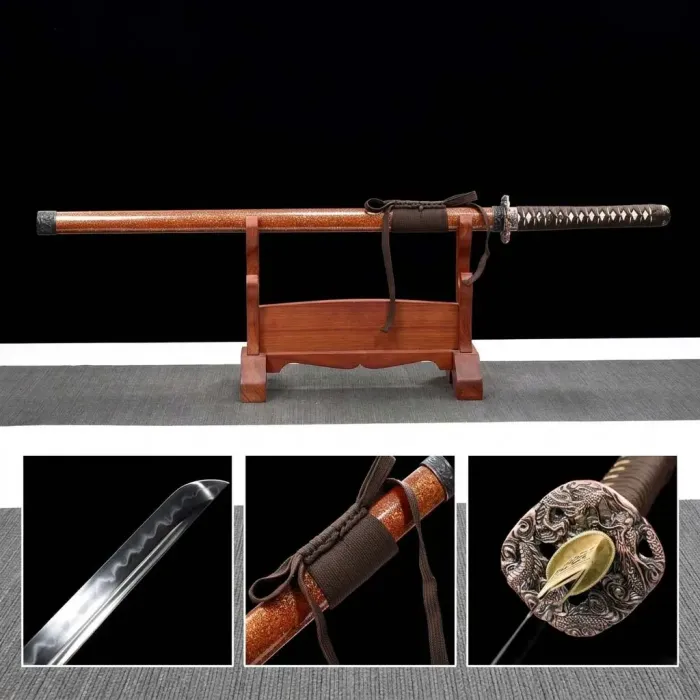
A conventional historical sword remains a exquisite masterpiece of skill, but assume you need to exhibit your unique mode? Adjusting your gear is a profound journey, allowing you to assemble a truly unique piece. From the hold wrapping and band to the covering design and cutting motif, each segment offers a chance for unique expression. This survey delves into the space of katana refinements, providing details for both learners and seasoned enthusiasts aiming to form their legacy on the age-old art of the samurai.
1060 Steel Katanas: The Beginner's Legitimate Mastery
For individuals excited to embark on the beneficial journey of katana handling skills , 1060 steel katanas present an ideal entry point. This defined grade of essential steel strikes a nice compromise between value and proficiency. While not as hard as top-tier steels, 1060 facilitates a fair level of whetting, making it suitable for novices to master the rudiments of blade preservation and appreciate the elegance of handcrafted Japanese weaponry. It’s a excellent choice for acquiring experience without the capital burden of more elite steels.
T Ten Alloy Weapons : Optimizing Excellence and Reasonableness
For enthusiasts seeking an authentic katana experience without breaking the budget , T10 steel katanas represent a compelling option. These weapons offer a significant improvement in robustness compared to middling alternatives, exhibiting reasonable edge retention and satisfactory flexibility for primary severing techniques. While not rivaling the outstanding characteristics of elite steels like T100 or folded alloy , T10 provides a impressive blend of functionality and profitability, making them a appreciated choice for rookies and those on a small earnings .
Past the Blade : Enhancing Your Edge's Ornaments and Handle
While the glazed cutting edge is undeniably the main point of a katana, truly refining its magnificence lies in the precise customization of its ornamentation and tsuka . This technique allows users to express their special flair . Think about the comprehensive possibilities: menuki - decorative accents that contribute visual attraction ; the hamon sleeves – often carefully engraved ; the tsuka center itself, wrapped in traditional ito rope ; and the fusa butt cap , which can be constructed from various elements like valuables or ivory .
- Select designs that connect with you.
- Assess with varying resources .
- Focus on robustness for a long-term result .
The Enchantment of the Katana: Past, Crafting, and Elements
This traditional armament bears a unparalleled allure, steeped in centuries of eastern history and practice . More than merely a weapon of conflict , it's a sign of the samurai ethos – a fusion of expertise and command . Its development spanned many generations, with early metallic weapons evolving into the slender curvature and lethal edge we identify today. The manufacture involved is truly spectacular, requiring decades of mentoring to become skilled in . The process involves a multifaceted folding of steel bloom , creating layers that strengthen the edge’s flexibility and shaving ability. Various schools of metalworking started , each with their special secrets and formulas for achieving the ideal equilibrium and edge - a truly strenuous pursuit.
- First Katana classes
- The importance of the traditional blade in samurai culture
- Traditional forging techniques
Picking the Appropriate Steel for Your Bladed Weapon Project: 1060 vs. T10
Opting for the ideal steel is fundamentally important for any armament project, and the option between 1060 and T10 can be complicated. 1060 is a favored American compound, offering a acceptable balance of toughness and hardiness, providing it quite easy to work. However, T10, a originating from Japan steel, usually boasts superior wear lastingness and can perhaps achieve a elevated end hardness, although it can be significantly hard to manage and requires careful heat processing. Consider your experience level and aimed features: for a novice, 1060 may be a better entry, while the experienced smith might use the improved characteristics of T10.
- Effortlessness of Handling
- Wear
- Maximum Firmness
Achieving Mastery: Complex Katana Adjustment Techniques
Advancing competence in blade refinement extends far beyond basic honing. Serious enthusiasts are now studying advanced techniques to truly liberate a blade's hidden potential. This involves intricate work with the blade border, utilizing specialized compounds for differential hardening and carefully electing the shape of the crossguard to optimize balance and capability. Beyond purely functional alterations, artisans are increasingly focused on generating unparalleled aesthetic grace, through complex embossing and layered polishes that truly transform a katana into a work of art.
From Elemental Metal to Artistry: Forging a 1060 Blade
The journey launches with standard 1060 fabrication , a resilient material far lacking the elegant katana it will develop into. Accomplished bladesmiths use a detailed process of layering and forming the crude steel, repeatedly burning it and hammering it to discard impurities and build a even grain structure. This tiring process, often lasting for periods , builds the important resilience and suppleness characteristic of a true Japanese weapon . Supplementary heat treatments , including exact hardening and curing , are critical to achieve the specific proportion of sharpness, stability and T10 steel katana elegance .- Combining: Diminishes impurities and creates grain structure.
- Molding: Molds the steel into the initial blade form.
- Hardening: Determines the final hardness and flexibility.
The Durable Charm of the Katana: Intensive Inspection of Steel and Adaptation
A iconic katana continues a strong symbol denoting Japanese culture , its allure far moving past mere armaments . Forged from rare steel and habitually featuring intricate trims, the process of creation itself is a sacred art. Beyond the basic craftsmanship, the ability to modify a katana - from the temper curve to the grip wrapping and clasp - opens for a sincerely individual communication for both worshippers and followers alike. This amalgamation of classical steelwork and boundless personalization creates the katana's continued widespread acceptance across the universe.
